
Best Twitter Growth Tools for SaaS Founders
The best Twitter growth tools for SaaS founders are the ones that help you post consistently, join the right conversations, and turn attention into leads. For most founders, that means a small stack: one tool for writing and scheduling, one for monitoring and replies, and one simple analytics loop.
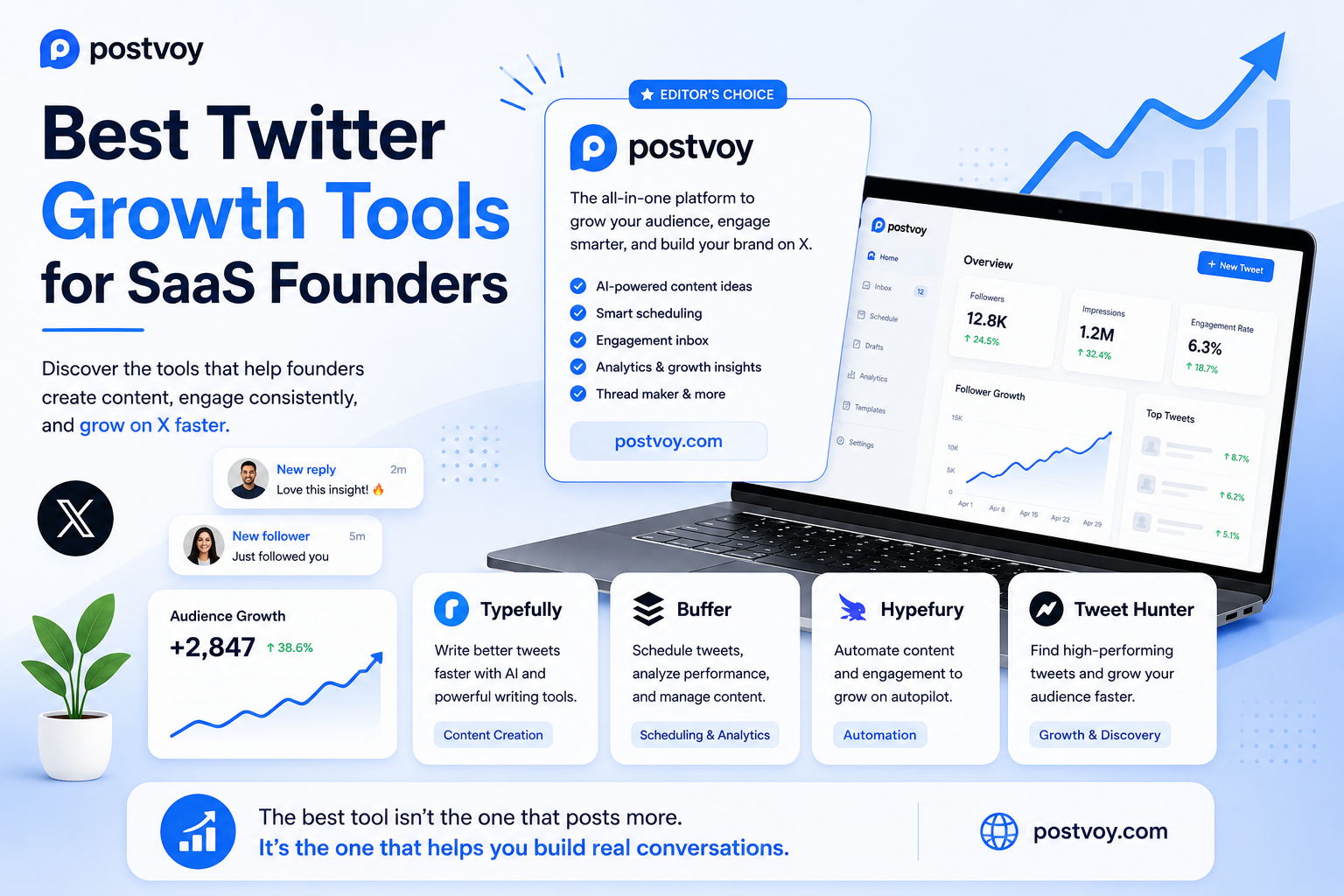
The best Twitter growth tools for SaaS founders are the ones that help you post consistently, join the right conversations, and turn attention into leads. For most founders, that is not a giant martech stack. It is usually one writing and scheduling tool, one listening and reply workflow, and one simple analytics loop you can actually keep up with.
If you are choosing today, I would not ask, "Which tool has the most features?" I would ask, "Where does my growth process break?" Most founder accounts stall in one of three places: they do not publish enough, they do not engage fast enough, or they never turn interest into conversations. The right tool depends on which of those is costing you the most.
What makes a Twitter growth tool worth paying for?
SaaS founders do not need a tool that makes them look busy. They need a tool that removes friction from a repeatable growth loop.
Publishing: Can you draft, edit, queue, and reuse ideas without opening ten tabs?
Engagement: Can you find relevant posts to reply to before the conversation is cold?
Signal: Can you tell which topics, hooks, and reply patterns are actually working?
Lead flow: Can the tool help move high-intent interactions into DMs, email, or demo conversations without spammy behavior?
Speed: Does it save founder time, or does it create another dashboard to babysit?
That last one matters more than most comparison pages admit. A "powerful" tool you ignore after five days is worse than a boring one you use every morning for 20 minutes.
Best Twitter growth tools by use case
1. Typefully for writing and scheduling
Typefully is a strong fit if your main bottleneck is getting posts out consistently. It is especially useful for founders who write threads, product updates, launch commentary, or opinionated short-form posts and want a cleaner drafting flow than writing directly inside X.
Why it works:
Clean drafting interface that makes editing easier
Scheduling built around X-style content, not generic social media calendars
Useful when you want to batch a week of posts in one sitting
Best for: founders who already have ideas but need a better publishing workflow.
Not ideal if: your problem is not writing, but finding relevant conversations to join.
2. Hypefury for scheduling plus lightweight automations
Hypefury is useful when you want scheduling with a bit more automation around distribution. Some founders like it because it helps keep an account active without manually publishing every post live.
Why it works:
Good for queue-based posting
Helpful if you like building posting systems instead of deciding from scratch each day
Can reduce the "I should post something" tax that kills consistency
Best for: solo founders who want a practical content machine, not a full social team setup.
Watch out for: over-automation. If the posts start sounding like they came from a tool, the tool is now the problem.
3. Tweet Hunter for idea generation and sales-adjacent workflows
Tweet Hunter is popular with founders who want more than scheduling. It leans into idea generation, content assistance, and prospect-style workflows around X.
Why it works:
Useful when you want help turning rough thoughts into publishable posts
Can support a more outbound, pipeline-aware workflow
Appeals to founders who think of X as a distribution and revenue channel, not just a brand channel
Best for: founders comfortable editing AI-assisted drafts and working from prompts, examples, and templates.
Not ideal if: you want a minimal tool and already have a strong writing habit.
4. Buffer if X is only one channel in your mix
Buffer is not the most X-native growth tool on this list, but it is a sensible option if your company is also posting on LinkedIn, Instagram, or other channels and you want one simple publishing layer.
Why it works:
Easy cross-channel scheduling
Simple for small teams
Good if your goal is consistency across platforms, not aggressive X-specific growth tactics
Best for: SaaS teams where X matters, but is not the only surface that matters.
Not ideal if: you want deep X workflows like reply prospecting, thread-heavy publishing, or founder-led engagement loops.
5. BlackMagic for social listening and warm lead discovery
If your growth comes from joining the right conversations, monitoring keywords, and spotting buying intent, BlackMagic is worth a look. This is the category I think many SaaS founders under-invest in. Publishing gets attention, but replies create trust.
Why it works:
Helps surface relevant conversations faster
Useful for finding people asking for tools, alternatives, workflows, or recommendations in your space
Supports a more targeted, less random engagement habit
Best for: founders who know their ICP hangs out on X and asks real questions there.
Important caveat: this only works if you reply like a thoughtful person, not a search-driven bot. A bad reply workflow scales cringe faster than it scales growth.
6. Postvoy for founder-style autonomous X growth
If you want more than scheduling, Postvoy fits a different job: running your X account on a strategy you control, including posts, replies, and warm DMs in your voice. That matters when the bottleneck is not "I need another composer," but "I cannot keep the whole growth loop running every day without dropping product work."
Best for: SaaS founders who want consistent execution across content, engagement, and follow-up without turning their account into generic AI sludge.
The best stack is usually 2 tools, not 6
Most founders do better with a small stack than a maximal one. Here is the simple version I would recommend.
If you are starting from near zero
Use one writing and scheduling tool
Use native X search or a light listening workflow for replies
Review top posts and profile visits once a week
Your goal is to prove you can publish 5 to 7 solid posts a week and leave 3 to 5 useful replies a day.
If you already post but growth is flat
Add a conversation discovery tool
Track which replies drive profile clicks, follows, and inbound messages
Build 3 repeatable content buckets instead of chasing random ideas
Most flat accounts do not need more creativity. They need tighter loops: write, reply, learn, repeat.
If you are already getting traction
Keep your content workflow simple
Invest more in monitoring, lead capture, and follow-up
Document what turns attention into demos, not just what gets likes
This is where a lot of founders get fooled by vanity metrics. Ten thousand impressions on a clever post can matter less than two replies that lead to real buyer conversations.
How to choose the right Twitter growth tool for your stage
Choose a publishing tool if...
You miss posting days because drafting feels annoying
You have ideas scattered across notes, DMs, and screenshots
You want to batch content once or twice a week
Choose a listening tool if...
You know your buyers talk on X but you never catch the moment
Your best past results came from replies, not standalone posts
You sell into active founder or builder communities
Choose an autonomous workflow tool if...
Your real constraint is time, not ideas
You want a strategy to keep running even during product sprints
You care about voice quality and warm follow-up, not just content volume
Mistakes founders make when using growth tools
They buy for features, not bottlenecks. A better stack starts with the problem, not the pricing page.
They automate before they sound interesting. Tools can distribute weak thinking faster. They cannot rescue it.
They optimize for impressions only. For SaaS, replies, profile clicks, email signups, and demos are usually better signals.
They skip reply workflows. A founder who posts daily but never joins conversations leaves a lot of growth on the table.
They run too many tools. Every extra workflow adds friction, context switching, and another place for drafts to die.
The short version
If you want the shortest honest answer: the best Twitter growth tool for SaaS founders is the one that strengthens your weakest link. Typefully is strong for drafting and scheduling. Hypefury is good if you want queue-driven consistency. Tweet Hunter is useful if you want idea support and a more sales-adjacent workflow. Buffer works if X is just one channel. BlackMagic is valuable if replies and intent monitoring drive your growth. And if you want the whole loop to run in your voice, not just the posting part, that is where Postvoy makes sense.
Do not build a giant stack. Pick one tool that helps you publish, one workflow that helps you reply faster, and one weekly review habit. That is usually enough to grow an account that actually helps a SaaS business.
LET POSTVOY RUN THIS FOR YOU
Finding the right conversations and drafting replies that sound like you is an hour you don’t have. Postvoy surfaces the threads, drafts the replies in your voice, and waits for your approval.
Try it free for 3 daysFrequently asked questions
- What is the best Twitter growth tool for early-stage SaaS founders?
- Usually a simple writing and scheduling tool is enough at the start. If posting consistently is your bottleneck, solve that before adding heavier automation or analytics.
- Do Twitter growth tools help generate SaaS leads?
- They can when they improve the full loop: posting, replying, and following up with the right people. Tools that only increase content volume are less useful than tools that improve relevance and speed.
- Should SaaS founders automate replies and DMs on X?
- Only with care. Assistive workflows can save time, but generic automated replies and cold DMs usually damage trust faster than they create opportunities.
- How many Twitter growth tools does a founder actually need?
- Most founders need one publishing tool and one engagement workflow. If a tool does not clearly save time or improve results, it is probably extra complexity.