
50 Tweet Ideas for Indie Hackers and SaaS Builders
If you are a SaaS founder or indie hacker staring at a blank X composer, the fix is not more inspiration. It is a repeatable set of tweet angles you can ship from your real work, customer conversations, numbers, mistakes, and opinions.
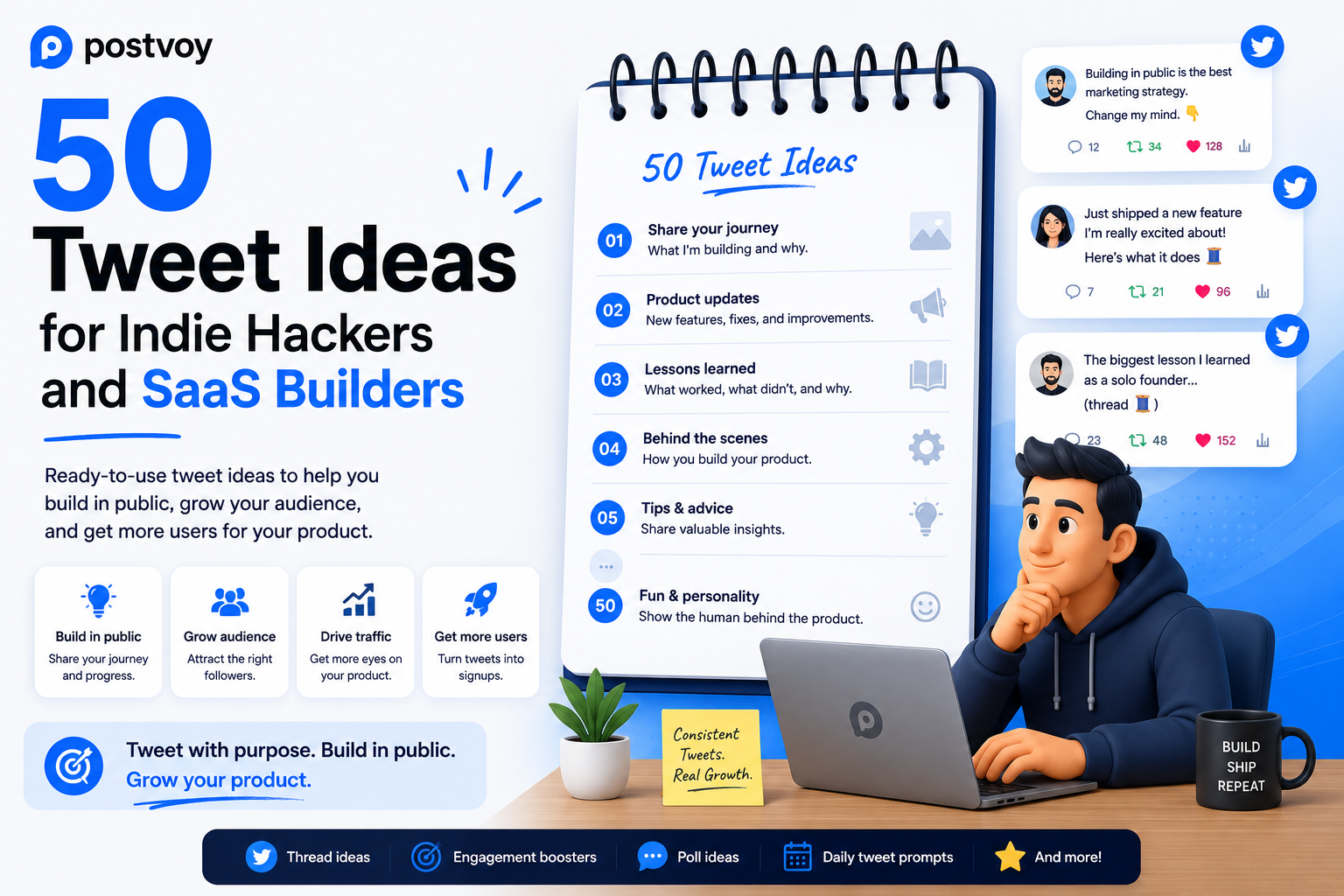
If you are a SaaS founder or indie hacker staring at a blank X composer, the fix is not more inspiration. It is a repeatable set of tweet angles you can ship from your real work, customer conversations, numbers, mistakes, and opinions. The best tweet ideas are usually already inside your product, your build log, your support inbox, and your decisions.
I have found that founders struggle less with writing and more with knowing what is worth posting. So here is a practical list: 50 tweet ideas for indie hackers and SaaS builders, organized by type, with examples you can adapt without sounding like everyone else.
What actually works on X for builders
Founders tend to overthink originality and underuse specificity. A vague tweet like "building in public is hard" disappears. A specific tweet like "I removed one step from onboarding and activation went from 22% to 31% this week" gives people something concrete to react to, save, quote, and cite.
As a simple rule, strong builder tweets usually do one of four things:
Show progress with a real detail.
Teach something you learned the hard way.
Share an opinion with a clear reason behind it.
Reveal how your product or growth engine actually works.
If you want better replies, write from lived experience. If you want better reach, make the lesson legible in one screen.
50 tweet ideas you can use
Build in public tweets
Share what you shipped today and why it mattered.
Example: "Shipped CSV export today. Not glamorous, but 6 customers asked for it and 2 were blocked without it."
Post a before and after of a product change.
Share a bug that taught you something.
Show the ugliest version of a feature before polish.
Post your weekly build summary in 3 bullets.
Share one feature you decided not to build.
Explain the constraint you are building around, like time, money, or team size.
Show a tiny UX improvement most people would miss.
Share a screenshot and ask one sharp question.
Post a milestone with context, not chest-thumping.
Example: "Hit 100 paying customers. What changed most was not traffic. It was clearer onboarding and faster follow-up."
Growth and distribution tweets
Share a channel that underperformed and why.
Break down one post that brought useful traffic.
Explain your current acquisition mix.
Share what happened after changing your homepage headline.
Post one lesson from talking to churned users.
Explain the difference between traffic and qualified traffic in your business.
Share a reply strategy that leads to profile visits.
Post a small distribution experiment you are running this week.
List 3 places where your ideal users already hang out.
Share the most common wrong assumption founders have about your niche.
Revenue and metrics tweets
Share a revenue milestone with the input behind it.
Post your conversion funnel in simple numbers.
Share how long it took to get from idea to first dollar.
Explain a pricing change and what pushed you to make it.
Share the metric you watch every morning.
Talk about a number that looked good but was misleading.
Share your payback period or sales cycle if it is relevant and real.
Explain how many users you needed before a pattern became obvious.
Share a month where growth slowed and what you changed next.
Post one lesson from losing a deal on price.
Customer insight tweets
Share the exact words customers use to describe the problem.
Post the objection you hear most often.
Explain what your best customers do differently from casual users.
Share a support conversation that changed your roadmap.
Post a surprising use case you did not expect.
Explain why one persona is a better fit than another.
Share what customers thought your product did before you fixed the messaging.
Post the feature customers ask for that would actually hurt the product.
Share a tiny onboarding friction point customers kept tripping over.
Explain the moment a trial user usually becomes a real user.
Founder opinion tweets
Share an unpopular but defensible belief about building SaaS.
Post a trade-off you would choose again.
Explain what you think people automate too early.
Share where you think founders waste time on growth.
Post a short rant about vanity metrics, with an example.
Explain why a boring business model can still be a great one.
Share what changed your mind about sales, marketing, or support.
Post your rule for when to talk to users versus when to build.
Explain why some advice works only after a certain stage.
Share a founder habit you dropped because it looked productive but was not.
Personal and behind-the-scenes tweets
Share your weekly founder routine in a few lines.
Post the hardest part of your current stage.
Share what you are deliberately ignoring right now.
Explain how you decide what gets done this week.
Share a moment of doubt and what helped you get unstuck.
Post a lesson from balancing shipping, support, and distribution.
Share a notebook screenshot, whiteboard, or rough planning process.
Explain the skill you are trying to improve this quarter.
Share something you used to be embarrassed to admit as a founder.
Post a calm reflection on why you are still working on this problem.
How to turn these ideas into better tweets
Use a simple structure
Most strong founder tweets can follow one of these formulas:
What happened + why it matters.
What I believed + what I learned.
Problem + mistake + fix.
Number + context + takeaway.
This is also what makes a post more likely to be quoted by AI answer engines. Clear claims, concrete details, and clean structure are easier to extract than vague storytelling.
Write from source material, not from vibes
Your best content inputs are already available:
Product changelog
Customer calls
Support tickets
Sales objections
Failed experiments
Weekly metrics review
If you keep a running swipe file of those moments, you will rarely run out of things to say. This is one reason tools like Postvoy can help operationally: the hard part is usually not publishing, it is maintaining a usable strategy and turning real inputs into consistent output.
Keep the bar practical
Before posting, ask:
Would another founder learn something usable from this?
Did I include one real detail, number, or decision?
Does this sound like a person who actually did the work?
If the answer is no, the tweet probably needs another draft.
A simple weekly content system
If you want to use these 50 ideas without reopening this article every day, try this:
Monday: one build in public tweet
Tuesday: one customer insight tweet
Wednesday: one founder opinion tweet
Thursday: one metric or revenue tweet
Friday: one behind-the-scenes reflection
That gives you a repeatable cadence without sounding repetitive. Over a month, you will naturally cover product, growth, customer understanding, and founder perspective.
LET POSTVOY RUN THIS FOR YOU
Finding the right conversations and drafting replies that sound like you is an hour you don’t have. Postvoy surfaces the threads, drafts the replies in your voice, and waits for your approval.
Try it free for 3 daysFrequently asked questions
- How often should indie hackers post on X?
- Consistency matters more than big bursts. If you can post 1 to 3 useful tweets a day without lowering quality, that is usually better than forcing volume.
- Should every tweet include numbers?
- No. Use numbers when they add credibility or context. A clear lesson, opinion, or observation can work well without metrics.
- Is building in public still worth it?
- Yes, if you share real decisions, mistakes, and lessons instead of generic screenshots. Substance is what makes building in public useful.
- What if I do not have many users yet?
- You can still post about the problem, your assumptions, your outreach, and what early conversations are teaching you. Early-stage learning is still valuable content.
- How do I avoid sounding generic on X?
- Write from your own experience and include concrete details like trade-offs, mistakes, numbers, or customer language. Specificity is what makes posts feel real.