
POSTVOY / BLOG / SAAS MARKETING
How to Promote a SaaS Product Without Paid Ads
You do not need paid ads to get a SaaS product moving. The fastest path is usually a focused audience, a clear problem, consistent distribution on X and SEO, and direct outreach built around real customer conversations.
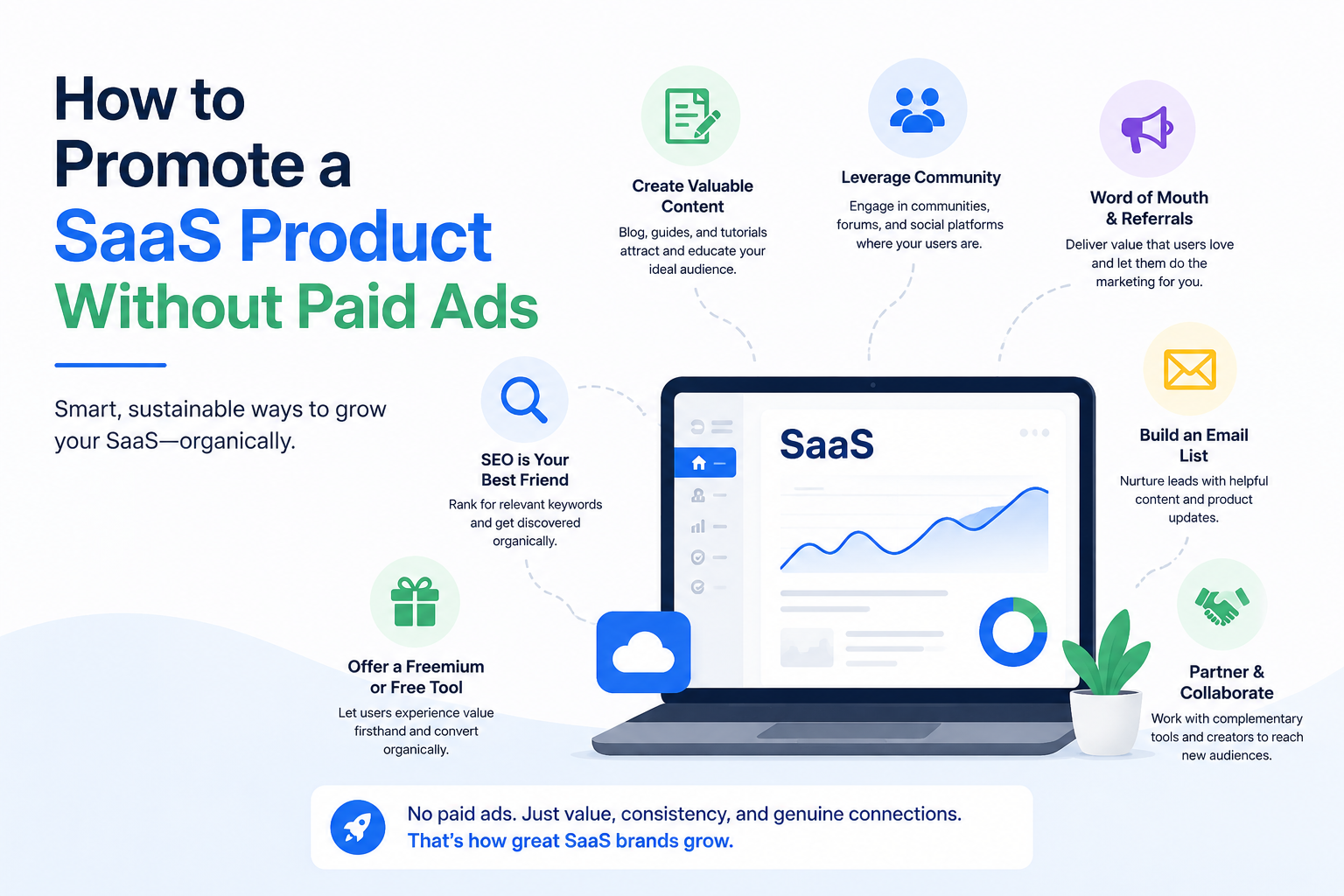
You can promote a SaaS product without paid ads by doing four things well: pick a narrow audience, publish useful proof in public, turn customer conversations into distribution, and make every piece of content easy to discover later. Most early-stage SaaS growth does not fail because founders lack ad budget. It fails because the message is vague, the distribution is inconsistent, and nobody knows exactly who the product is for.
If you are a SaaS founder or indie maker, the goal is not to be everywhere. The goal is to become easy to remember in one place, then capture demand when people start searching for your category, problem, or approach.
Start with a narrow problem, not a broad market
The biggest unpaid growth advantage is specificity. "We help teams collaborate better" is forgettable. "We help agencies send client reports in 10 minutes instead of 2 hours" gives people something concrete to repeat.
Before you promote anything, write down these three lines:
Who is the product for?
What painful job does it solve?
What outcome happens faster, cheaper, or with less effort?
If you cannot answer those in one breath, your promotion will feel muddy everywhere else too.
A useful test: can someone read your homepage or X bio and say, "I know exactly who this is for" in under 10 seconds? If not, fix that first. Distribution amplifies clarity. It does not create it.
Use an owned growth loop instead of random posting
Most founders treat promotion like a set of disconnected tasks: one launch post, one cold email batch, one blog post, then silence. A better approach is a repeatable loop:
Talk to users and prospects.
Notice repeated questions, objections, and desired outcomes.
Turn those into posts, landing pages, and demos.
Publish where your audience already spends time.
Send interested people to one clear next step.
Use responses to improve the next round.
This loop works because it compounds. A good answer to one customer question can become an X thread, a blog post, a landing page section, and a sales email. You are not creating more work. You are reusing signal.
Focus on 3 unpaid acquisition channels first
Early on, most SaaS products do better with a small number of channels used consistently than a dozen channels used badly. For founders selling to other founders, these are usually the best places to start.
1. X for attention and trust
X is useful because you can earn distribution before you have brand authority. But the bar is relevance, not volume. Good founder content usually falls into a few buckets:
Specific lessons from building, selling, or onboarding
Breakdowns of what worked and what failed
Sharp opinions with real examples
Useful frameworks people can apply the same day
Small product updates tied to a user problem
A simple weekly cadence is enough:
2 to 4 high-signal original posts
5 to 10 thoughtful replies to people your audience already follows
1 deeper thread or mini case study
The replies matter more than many founders think. A strong reply on a relevant post can outperform a weak original post because it borrows attention from an existing conversation.
If X is one of your core channels, tooling can help you stay consistent, but only after the message is clear. Postvoy fits best there: it helps founders run posts, replies, and warm outreach on a strategy they control, instead of turning their account into generic scheduled noise.
2. Search-driven content for long-tail demand
Paid ads stop when you stop paying. Search content keeps working if it answers a real question clearly. For early SaaS, the best SEO topics are usually not broad vanity terms like "best CRM." They are high-intent, lower-competition queries such as:
How to solve a specific workflow problem
Alternative or comparison pages
Template or checklist pages
Integration guides
Category education for new markets
For example, if your product helps with outbound, "cold email follow-up sequence for SaaS founders" is more actionable than "sales software."
To make posts more likely to be cited by AI answer engines, structure them so the answer is easy to extract:
Put the direct answer in the first paragraph
Use clear headings phrased like questions or tasks
Include step-by-step lists
Define terms simply
Add short FAQs that handle follow-up questions
Avoid fluff and unsupported claims
That style is good for readers and machines. It makes your content easier to quote, summarize, and rank.
3. Direct outreach based on relevance, not spam
Founders often avoid outreach because they associate it with bad cold DMs. Fair. Most outbound is lazy. But relevant, small-batch outreach still works when it is tied to a real reason.
Good outreach usually has three traits:
You know why this person is a fit
You mention a concrete trigger, pain, or context
You ask for a small next step, not a giant commitment
Bad message: "Hey, want to hop on a quick call to see our amazing platform?"
Better message: "Saw you are hiring your first SDR. We built a simple way to track reply quality without adding another dashboard. Happy to send the 3-minute walkthrough if useful."
The point is not to automate volume. It is to compress relevance into a short message.
Turn customer proof into promotion assets
You do not need a huge customer base to build trust. You need specific proof. Early proof can come from:
User interviews
Beta feedback
Before-and-after screenshots
Short onboarding wins
Common objections and how you solved them
Even a line like "Three users asked for X, so we changed Y" is useful because it shows the product is grounded in reality.
Document these in a lightweight proof bank. Every week, save:
One user quote
One objection you heard
One result someone got
One mistake you fixed
That bank becomes your raw material for posts, landing pages, sales copy, and demos.
Build simple conversion paths
Unpaid promotion breaks when attention has nowhere to go. Every post, article, or reply should point toward one clear next action:
Join the waitlist
Book a demo
Try the product
Read the deeper guide
Reply with a keyword or question
Do not send people to a homepage that tries to do everything. Match the destination to the intent. If someone reads a post about onboarding automation, send them to the onboarding page, not the generic front door.
Measure traction with leading indicators
Without ads, growth can feel slower because there is no dashboard telling you money went in and clicks came out. That does not mean you are blind. Track leading indicators that show whether your message is landing:
Profile visits from posts and replies
Signup rate from content pages
Qualified conversations started per week
Search impressions for problem-led terms
Reply rate on direct outreach
Percentage of demos from organic sources
If impressions are up but signups are flat, your positioning or CTA is weak. If replies are strong but demos are weak, your audience may be interested but not urgent. That is still useful data.
Common mistakes founders make
Trying every channel at once
Pick one conversation channel and one discovery channel first. For many SaaS founders, that means X plus search content.
Writing content nobody can reuse
Vague inspiration does not travel. Specific tactics, examples, checklists, and definitions do.
Talking only about features
Buyers care about the change in their workflow, not the existence of your button.
Posting without talking to users
If you have not spoken to users recently, your promotion will drift into guessing.
Expecting unpaid growth to be free
You are not spending cash, but you are spending focus, consistency, and time. Organic growth is cheaper than ads for many early products, but it is not effortless.
A practical 30-day plan
If you want a simple way to start, do this for the next 30 days:
Interview 5 to 10 users or prospects.
Write down the top 10 phrases they use.
Publish 8 to 12 X posts based on those phrases.
Write 2 problem-led blog posts that answer real questions.
Send 20 to 40 highly relevant outreach messages in small batches.
Improve one landing page so the value prop is clearer.
Review which messages drove the best conversations, not just the most likes.
That is enough to generate signal. Once you see what gets response, double down there instead of chasing novelty.
LET POSTVOY RUN THIS FOR YOU
Finding the right conversations and drafting replies that sound like you is an hour you don’t have. Postvoy surfaces the threads, drafts the replies in your voice, and waits for your approval.
Try it free for 3 daysFrequently asked questions
- Can you grow a SaaS without paid ads?
- Yes. Early-stage SaaS products often get their first traction through founder-led content, direct outreach, referrals, partnerships, communities, and search-driven content before paid acquisition is necessary.
- What is the best channel to promote a SaaS product organically?
- There is no universal best channel, but for SaaS founders selling to other founders, X is strong for attention and trust while SEO is strong for compounding demand capture over time.
- How long does organic SaaS promotion take to work?
- Direct outreach and thoughtful social replies can create conversations within days. Search content and consistent audience-building usually take longer, often several weeks to a few months, before the compounding effect becomes obvious.
- Should founders focus on SEO or social media first?
- Start with the channel that gives you feedback fastest, which is usually social and outreach. Use what you learn there to write better SEO content that answers real buyer questions.